

The EDP Execution Type is primarily intended for use cases where you need to calculate all the individuals that belong in a particular Segment. For Segments of type EDP, the platform supports several authoring methods: Simple, Advanced, and Traditional. This article focuses on the Traditional authoring method.
Segment Rules define the criteria for Members to be selected by this Segment. For the Traditional authoring method, the Rules tab displays the standard Loyalty condition-builder, which allows you to select an Attribute or field, select a mathematical operator, and select or enter a value. Multiple Rules can be joined with either an AND or an OR operator.
This article assumes that you have already created the Segment, and configured its properties as follows (for more information, see
-
Execution Type: EDP
-
Authoring Tool: Traditional
To define the Segment Rules in an EDP Segment using the Traditional authoring tool:
-
Select Members from the top navigation bar, then select Segments from the side navigation menu. The Segments screen is displayed.
-
Search for and select the desired Segment (see
-
The first drop-down menu is populated with all of the different object types in Loyalty that are available for use. From this drop-down menu, select one of the following object types to expand it and see the available options:
 Demographics
This option allows you to define a logical statement based on a value in a demographic field.
-
From the menu, select the desired demographic field.
-
Some demographic fields allows you to pick a value from among a range of pre-defined values. For these types of demographic fields, select the radio button for the desired value.
-
Other demographic fields present you with a drop-down menu, from which you can select a mathematical operator. Then enter or select a value.
Preferences
This option allows you to define a logical statement based on a value in a Member Preference.
-
From the menu, select the desired Member Preference.
-
Select a mathematical operator.
-
Enter or select a value.
Campaigns
This option allows you to define a logical statement using a Member's response to receiving a marketing campaign.
-
From the menu, select the desired Member response: Clicked a Campaign, Opened a Campaign, or Sent a Campaign.
-
Select a mathematical operator.
-
Enter or select a value.
-
Optionally, define a time period based on when the campaign was sent, such as "Is In Last 3 Months."
-
Optionally, define a time period based on when the Member action occurred.
Note: The use of a time period is optional, but recommended to improve system performance.
Events
This option allows you to define a logical statement using a selected Event Type.
-
From the menu, select the desired Event Type.
-
Select a mathematical operator.
-
Enter or select a value.
-
Optionally, define a time period based on when the campaign was sent, such as "Is In Last 3 Months."
Note: The use of a time period is optional, but recommended to improve system performance.
Orders
This option allows you to define a logical statement by performing a mathematical calculation on Members' purchase history.
-
From the menu, select the desired calculation method: Count, Recency , or Total Amount.
-
Select a mathematical operator.
-
Enter or select a value.
-
For Count or Total Amount, optionally define a time period, such as "Is In Last 3 Months."
Note: The use of a time period is optional, but recommended to improve system performance.
Segments
This option allows you to define a logical statement based on a Member's inclusion in a Segment (or exclusion from a Segment).
-
From the menu, select Member.
-
Select a mathematical operator - either In (inclusion) or Not In (exclusion).
-
Search for and select a published Segment.
Activities
This option allows you to define a logical statement by counting the occurrences of a selected Activity Type.
-
From the menu, select the desired Activity Type.
-
Select a mathematical operator.
-
Enter or select a value.
-
Optionally, define a time period, such as "Is In Last 3 Months." The use of a time period is optional, but recommended to improve system performance.
Metrics
This option allows you to define a logical statement using a Member's history of Metric usage.
-
From the menu, select the desired usage type: Balance, Earn, Expire, or Redeem.
-
From the second drop-down menu, select the desired Metric.
-
Select a mathematical operator.
-
Enter or select a value.
-
For the Earn, Expire, and Redeem Metric usage types, define a time period, such as "Is In Last 3 Months." The use of a time period is optional, but recommended to improve system performance.
Helpers
This option allows you to define a logical statement by referencing either a Lookup table or a Member Function.
-
From the menu, select either Lookup or Function.
-
From the second drop-down menu, select the desired Lookup table or Member Function.
-
Select a mathematical operator.
-
Enter or select a value.
-
If you selected a Lookup table and it has Parameters defined, select the Attribute on which to match.
-
If you selected a Member Function and it has Arguments defined, select the Attribute on which to match.
Machine Learning
This option allows you to define a logical statement based on a value in a Machine Learning (ML) Attribute.
-
From the menu, select the desired ML Attribute.
-
Select a mathematical operator; the available operators will vary based on the Data Type of the item you selected above.
-
Enter or select a value.
Calculations
This option allows you to define a logical statement based on a value in a Calculated Attribute.
-
From the menu, select the desired Calculated Attribute.
-
Select a mathematical operator; the available operators will vary based on the Data Type of the item you selected above.
-
Enter or select a value.
Attributes
This option allows you to define a logical statement based on a value in a Member Attribute.
-
From the menu, select the desired Member Attribute.
-
Select a mathematical operator; the available operators will vary based on the Data Type of the item you selected above.
-
Enter or select a value.
Custom Objects
This option allows you to define a logical statement by referencing a Custom Object.
-
From the menu, select either the desired Custom Object.
-
Select a mathematical operator.
-
Enter or select a value.
-
Optionally, define a Condition that limits what records from the Custom Object are included.
Expression
This option allows you to define a logical statement using a Groovy expression.
-
From the menu, select Advanced Expression.
-
In the code editor field, enter the desired Groovy expression.
-
Repeat the above steps as needed to define more Rules. Optionally, to delete a Rule, click the Delete icon next to it.
-
Once you define more than one Rule, select the logical operator from the Include customers that meet drop-down menu:
-
All of the following: Use an 'AND' operator such that all Rules must be true for a record to be selected.
-
Some of the following: Use an 'OR' operator such that at least one of the Rules must be true for a record to be selected.
-
-
Optionally, you can also organize Rules into Rule Groups. A Rule Group allows you to build more complex selection criteria. To create a Rule Group, click the Add icon, then select Add Rule Group. The platform creates a Group, which is represented visually as a nested box with its own operator and Add icon. Within this Group box, click the Add icon to define the Rule (or Rules) using the same process as described above. Use the toggle within the Group box to define the logical operator for the Rules within the Group. To delete an entire Rule Group, click the Delete icon just above the nested box representing the Group.
Note: By clicking the Group button inside the Group box, you can create "nested" groups.
-
Click Save. The platform refreshes the audit chart on the right, which indicates the number of selected Members out of the total population of your database. The Rule logic is displayed beneath the audit chart.
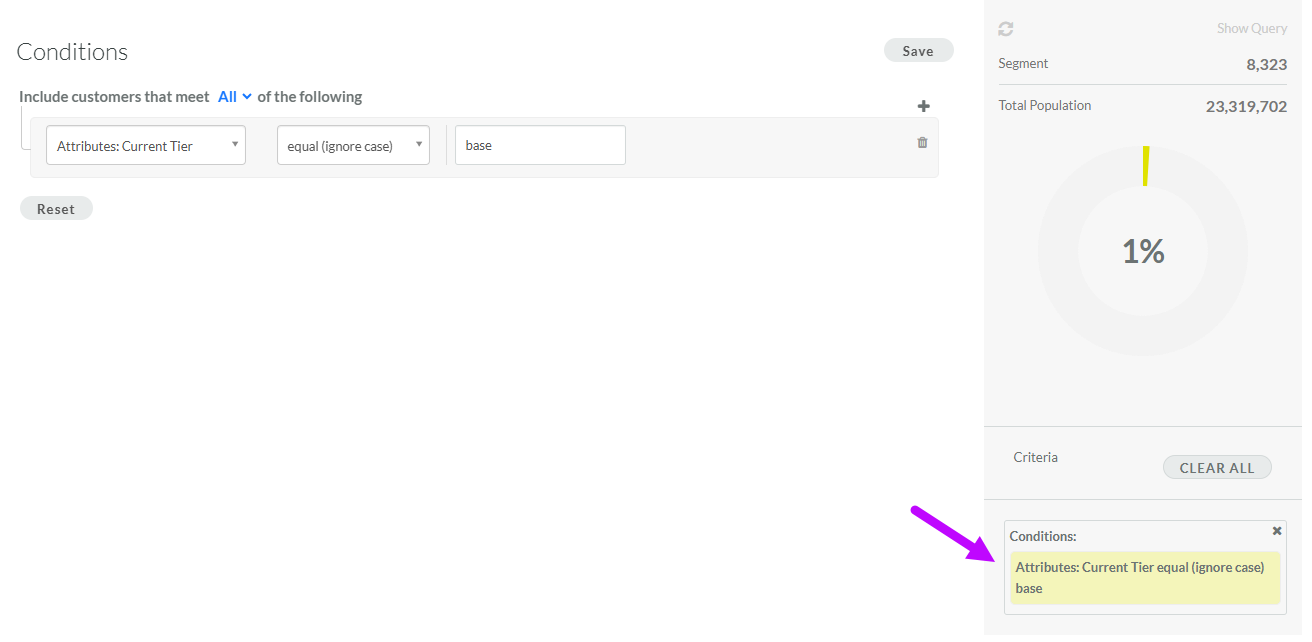
Note: At any time, you can click the Refresh icon within the audit chart to update the selected Member count.
-
Optionally, to delete all previously defined Rules and start over from scratch, click Reset.
